Wide Awake at 3 A.M.? You Might Be Onto Something Big
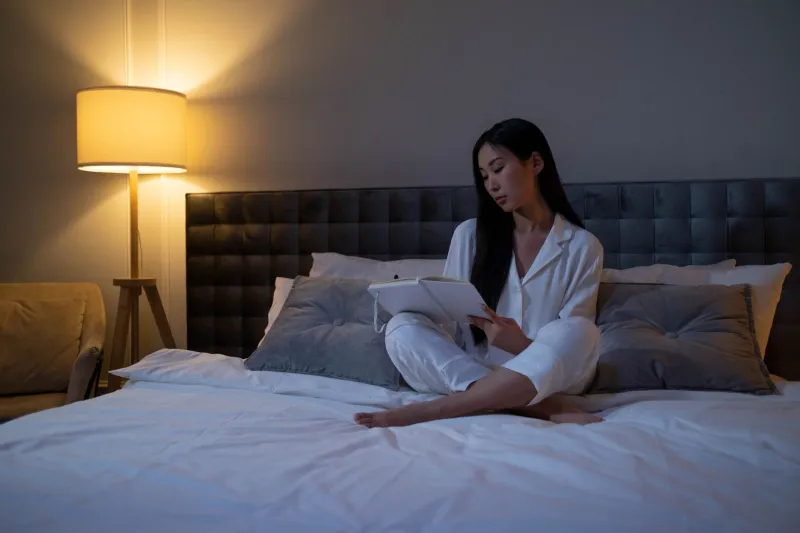
You know the feeling. The room is pitch black, the house is completely still, and your eyes snap open for absolutely no reason. The clock reads 3:07 a.m. Your first instinct is probably mild panic — great, now I'll be exhausted tomorrow — followed by a futile attempt to force yourself back under.
But what if that instinct is completely backwards?
A surprisingly large and quietly growing community of Americans is choosing to do something different when the witching hour hits: they're getting up, making tea, cracking open a journal, and treating the whole thing like a gift. They call themselves — half-jokingly, half-seriously — the 3 a.m. club. And the science backing their weird little habit might make you want to set an alarm.
The Ancient Rhythm You Forgot You Had
Here's the thing most people don't know: sleeping straight through the night for eight hours is actually a pretty recent expectation. Before artificial lighting reshaped modern life, humans commonly practiced what sleep historians call biphasic sleep — two distinct sleep periods with a quiet, wakeful interval in between.
Roger Ekirch, a historian at Virginia Tech, spent years combing through pre-industrial diaries, court records, and literature and found consistent references to a "first sleep" and "second sleep" separated by an hour or two of calm wakefulness. People used that window to pray, have conversations, interpret their dreams, or do light creative work by candlelight. It wasn't insomnia. It was just... how sleep worked.
Fast-forward to today, and that same biological rhythm is still quietly ticking inside a lot of us — only now we're calling it a disorder instead of a feature.
What's Actually Happening in Your Brain at 3 A.M.
When you wake up in that middle stretch of the night, your brain isn't in chaos. In many ways, it's in a remarkably interesting state. You've already cycled through the deepest phases of slow-wave sleep, which means your body has done a lot of its physical repair work. What's left is lighter, more dream-adjacent territory.
Researchers have noted that the hypnopompic state — that fuzzy, half-in-half-out zone between sleep and full wakefulness — is associated with loosened cognitive filters. The same rigid, logical thinking that governs your 2 p.m. spreadsheet brain? It's offline. What's running instead is something more associative, more symbolic, more weird in the best possible way.
That's the headspace artists have been chasing forever.
Neuroscientist Andrew Smart and others studying default mode network activity have observed that the brain's "resting" state is anything but passive — it's a hotbed of creative synthesis, pulling threads from memory, emotion, and imagination in ways your focused waking mind simply doesn't have the bandwidth to do. The 3 a.m. wake-up, for some people, is a direct window into that mode.
Real People, Real Rituals
Across Reddit threads, journaling communities, and creative forums, Americans are quietly documenting what happens when they stop fighting the early wake-up and start working with it.
A graphic designer in Austin describes keeping a sketchbook on her nightstand specifically for these windows. "I don't turn on overhead lights — just a little lamp," she wrote in one thread. "I draw whatever's still floating from the dream. Some of my best client work started as a 3 a.m. scribble."
A freelance writer in Chicago said he started keeping a voice memo app open because he couldn't write fast enough. "My brain makes connections at that hour that I genuinely cannot replicate during the day. It's like a different person lives in me between 3 and 4."
Then there's the meditation angle. A number of practitioners — particularly those drawn to contemplative or spiritual traditions — consider the pre-dawn hours sacred for exactly the reasons science is now catching up to. The Vedic tradition refers to the period before sunrise as Brahma Muhurta, literally "the creator's hour," long considered optimal for meditation and insight. Monks, mystics, and now sleep-deprived creatives in Brooklyn seem to agree.
How to Actually Use It (Without Wrecking Your Sleep)
Okay, so you're intrigued. But you also don't want to turn a one-off wake-up into a full-blown sleep disruption pattern. Fair. Here's how people in the 3 a.m. club tend to approach it without spiraling:
Don't reach for your phone first. The blue light and the scroll will immediately yank you out of that dreamy, associative state and plug you into the anxiety machine. Give yourself at least fifteen minutes before any screen contact.
Keep your supplies close. A journal, a sketchbook, or even just a notepad on the nightstand means you don't have to fully wake up to capture whatever's moving through your mind. The less friction, the better.
Stay warm and low-lit. Bright lights signal "daytime" to your brain and make it much harder to drift back to sleep when you're ready. A small bedside lamp or even a candle (safely placed, obviously) keeps the vibe soft enough to slide back into sleep after your session.
Set a gentle time limit. Most people in this community cap their middle-of-the-night creative window at 45 minutes to an hour. After that, they return to bed with every intention of finishing their second sleep — and most say they do.
Don't force it. On nights when 3 a.m. arrives and you feel genuinely, deeply sleepy? Sleep. This isn't about manufacturing a routine — it's about responding to a natural signal when it shows up.
The Reframe That Changes Everything
The biggest shift isn't behavioral — it's mental. The moment you stop treating a middle-of-the-night wake-up as a problem and start treating it as an unexpected pocket of creative time, the whole experience changes texture.
Anxiety about not sleeping is one of the most common reasons people can't get back to sleep. The stress response kicks in, cortisol rises, and suddenly you're lying there wide-eyed at 4:15 a.m. calculating how many hours you have left. But if the wake-up is intentional — or at least welcomed — that spiral doesn't have the same grip.
There's something almost poetic about it, honestly. The world is asleep. Your inbox is quiet. Nobody needs anything from you. It's just you and whatever strange, half-formed ideas are drifting up from the depths of your dreaming mind.
Droomit is literally built around the idea that dreams — the ones you have at night and the ones you carry around during the day — are worth paying attention to. And maybe the 3 a.m. wake-up is just your brain's way of saying: hey, I've got something for you. You coming?
Next time it happens, maybe don't hit snooze on that.